Wednesday, 12 December 2012

A short day down Owl Hole.

 We've been to Owl Hole before (infact it was the first "real" caving we did) and as we only had a short day we headed back there. The plan this time was to take the DSLR with us and all the lights in an attempt to get some amazing photographs. Below are the results, in for of a photo essay than an actual post. The first set are fromheading down into the Cascade Chamber. This is a chambers that's been heavily scaffolded as it's still rather loose. We only really went half was down it and stopped to view the Cascade, a beautiful flowstone waterfall, which looks like it's been frozen in time. Sadly your lighting wasn't up to it and it's so delicate that moving around just to place the lights would have damaged some delicate features of this cave. I don't think our photo's do it justice, but you'll get the idea.

(Chink, attempting to photography some flowstone)
(What Chink was actually photographing. Evidence of flowstone in cross-section, as it's been damaged, showing the layering as its formed over a bed of sand)

(Flowstone ridges on the cave walls)

(Tiny pools, each filled with growing crystals in water. I have no idea how these have formed)

(Possibly the same surface as the photo above, but taken from another angle)

(Looking back towards the shaft from the Cascade Chamber, with the scaffolding visible and stalagtubes growing from the ceiling)

(The second scaffolded shaft that leads off from the cascade chamber)

(Finney for scale, half way up the shaft to get out of cascade chamber)

(The best of the cascade shots. It really was so hard to get some decent lighting in there and because my headtorch was so bright the light reflexed back loads)


 We next intended on heading into the Crystal Pallas Chamber so after aiding back up to it and getting the gear inside, we actually ended up staying in the small chamber taking photo's before actually carrying on. We then moved into the Crystal Pallas and climbed down into the Gour chamber and had a proper little explore down there. The Gour chamber was worth the down climb and crawl, even if it made me muddier than ever before.

(Columns (above and below), light from behind the camera)


(a small inlet in the wall, with various small columns in it. We thought that at one time I must have been filled with water, as there is a significant widening of the column and the "edge" of the pool)

(A small curtain that joins into a small column, lit from behind)
(Crystals formations on edge of a curtain)
(a small pool, with several beds of tiny crystals growing in it)

And from the Gour chamber and Crystal Pallas:
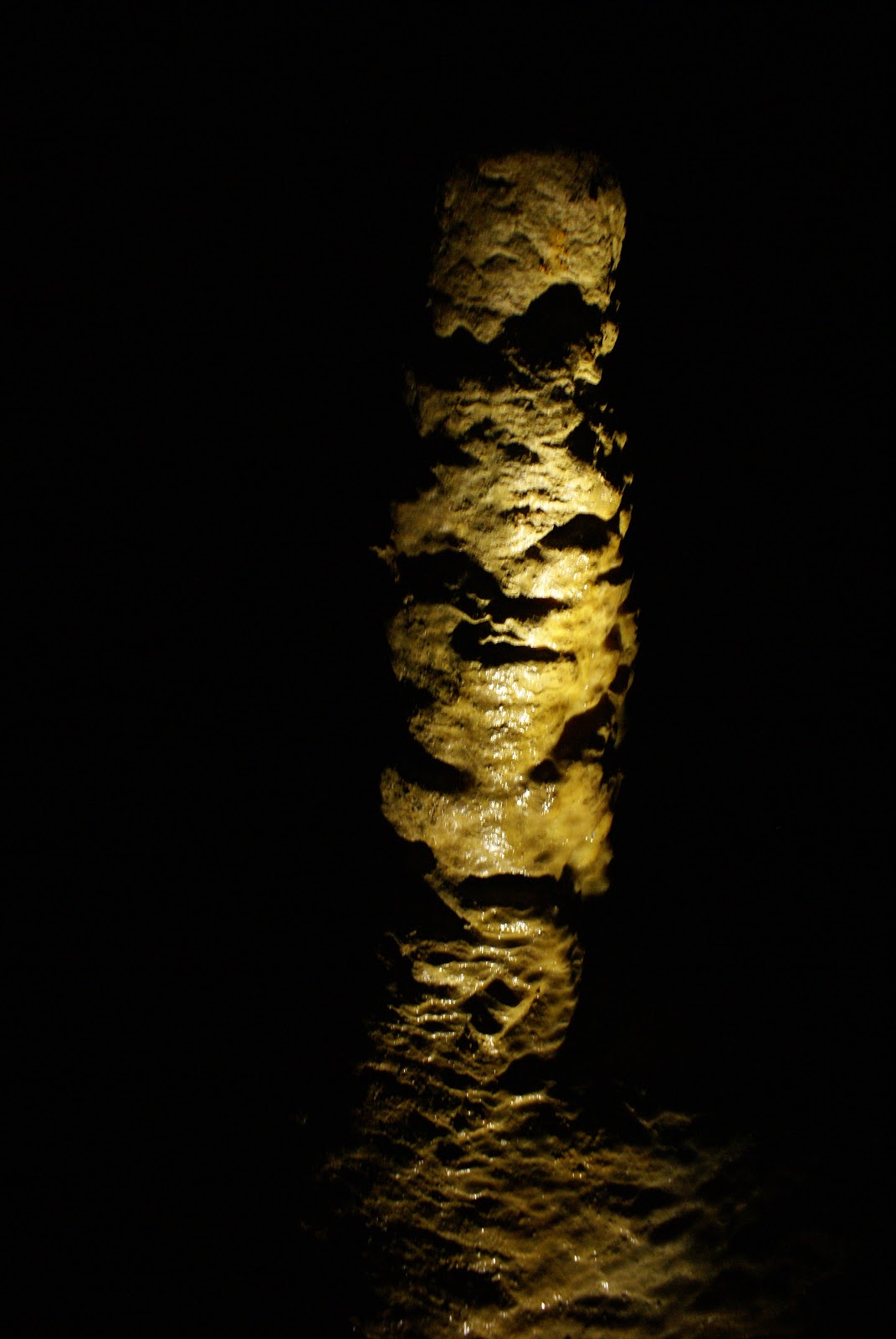
(Beautiful speolotherms taken with no flash and my headtorch as lighting)
(Same view, but with 8 seconds long exposure instead)
(The sump at the base on the gour chamber. I don't know if it dries up or leads anywhere but there's always the hope that it'll open up into a new system!)


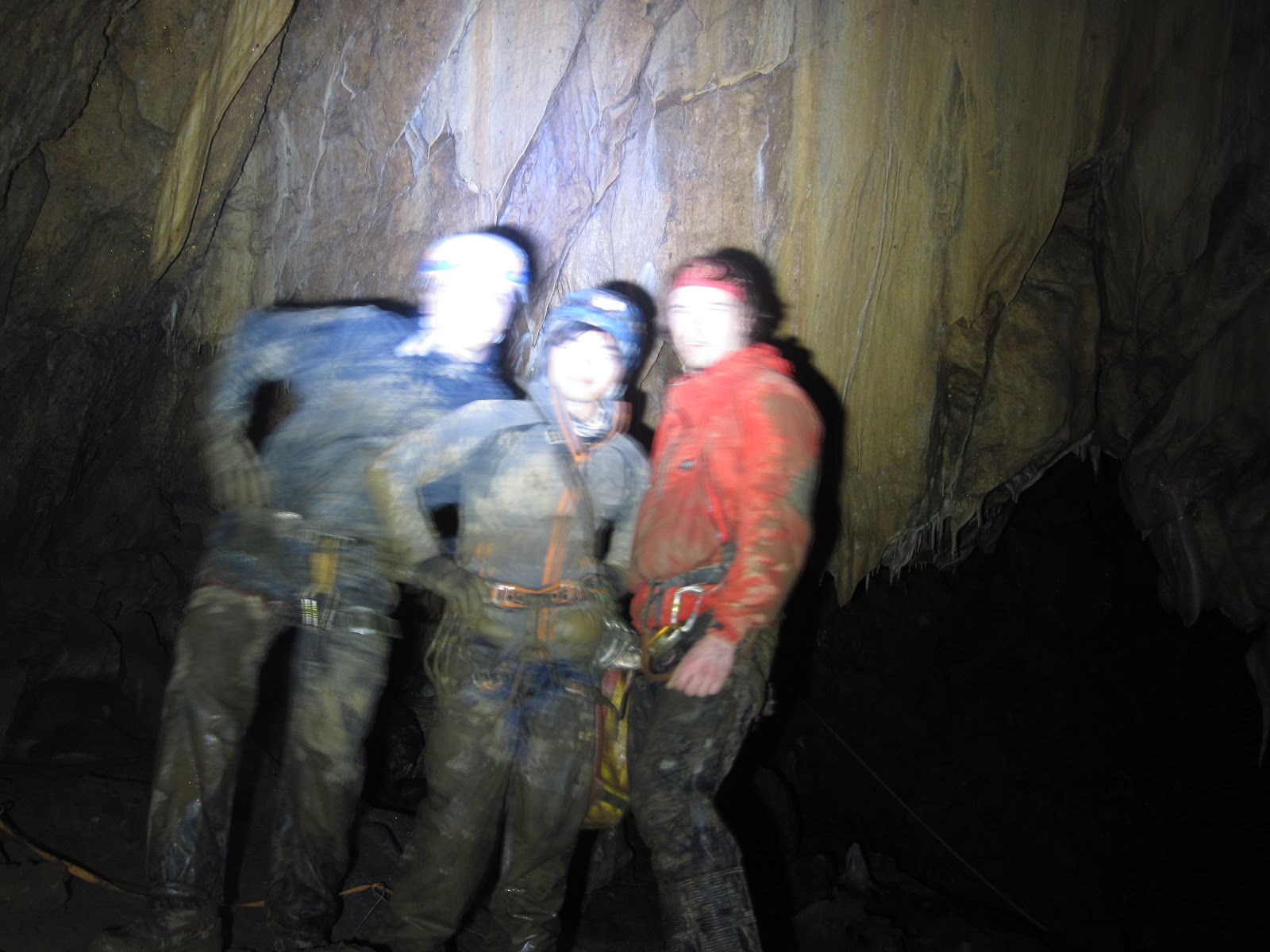
Sadly the shots actually inside the gour chamber didn't come out very well at all, and thus haven't been included. There's no team pic from this trip because by the time we'd got out we were all literally covered in mud, and it was cold. Still wasn't a bad trip.
 

Monday, 10 December 2012

Lay-by Pot (a though trip)

With a week of bad weather behind us and the knowledge that when it rains, that rain eventually finds it's way under ground and into caves systems be decided on to mess around. We went straight to Hitch and Hike that morning to talk to Shaun behind the counter about caving and what would be a sensible idea for the day. He suggested a range of little places and caves but there was one that stood out a little more. It was Lay by Pot. It stood out because it would a journey through a cave, rather than in and out the same way like we'd done before. He did warn us that it would be a little wet but we'd been plenty wet already so it didn't bother us.

Lay by Pot is just off the road in Stoney Middleton Dale, where we seem to spend most of our caving time. It starts with a abseil down a 14 metre shaft before meandering through the surrounding rock to exit at somewhere called the oil drum entrance.

Our first challenge for the day was actually finding the entrance and between not reading the guide book properly (parked in the wrong place) and then having quite a few little caves to check on the way it took us a while to actually get there. I volunteered to go first down the rope and clipped myself in with my gri-gri (I'm yet to aquire a petzl stop) and shot off down the rope. Abseiling on a gri-gri in a tight space is something I don't recommend at all. It's a really really awkward piece of kit to use if you're all cramped up. It wasn't that bad really and I ended up in a chest height passage in which I made myself comfortable and waited for Finney to come down.

Finney took forever, or it seemed like he did at least! I just made myself comfortable and picked at the crumbly ceiling looking at the fossils I was finding. The passage has a lot of loose material in it, which looked like it had come from the roof. He told me when he'd got down that he'd had one of those moment when you look at your belay device and think “how in god's name does this thing work”. Abseiling into a tight passage is a pretty stressful thing to do and I'm not surprised his brain was running overtime. We sat there eating jelly babies and taking photos till Ronnie joined us.

There are two passages off which lead off once you get down. We'd already been warned about following the tight squeeze of old man's slabbed level, which doesn't go anywhere really. We set off crawling down the right passage with the cheese grate being our first check point. I don't know why the cheese grater is called what it is as it's not cheesey or gratery (if that's even a word). Instead its a 7 metre drop into a pool with a small stream running into it. I guess the pool must drain from somewhere, but we didn't exactly dive in and have a look. There's something about water in caves that really scares me. Just after here we came across our first obstacle... a low passage with a puddle of water about 6/8 inches deep. I'm sure hardy cavers would have laughed at us deliberating whether to carry on or not but being honest I didn't fancy a soaking so early on in the cave. We didn't really know how long we actually be down there and being cold and wet is a lot worse than just being cold.

I squeezed out the other side with wet hands, arms, elbows, knees and one wellington full of water... but it wasn't that bad. I'd managed to get the kit bag through as well without it getting too wet either. The passage ahead we up slightly and we piled into it to check out the stalactites. It's a shame that we didn't just carry on into the Calcite passage and instead just plough on ahead with our journey. I think we'd all decided that this was caving trip, so a bumble underground to take pretty pictures. Still the passage we were in had some beautiful stalagtubes hanging down from the ceiling and after a bit of backing up and me sending Ronnie in the wrong direction we got moving again.

Ronnie was pretty much leading this cave, with me behind him checking the map every so often. Finney had acquired the camera and we found out later that he'd been recording little personal documentaries while Ronnie and I had been off ahead. He's fast becoming the team camera man! With Ronnie up ahead all I generally got every time he entered a tunnel a mix of laugher and groaning. The first puddle we suffered was not the last, and not the worst either. I followed each one, fighting with the bloody kit bag each time to try and keep it dry as I'd not stuffed everything in waterproof bags. It was something that I'll remember for next time.

I wasn't until we reached the first of the larger chambers that me and Finney could get off our hands and knees. Ronnie on the other day had been able to get a couch on in some of the passages and chambers, which made me very jealous. The chamber although quite large in plan, wasn't actually that big apart for a aven that had formed in the centre. Normally people sit down to take a break, but we all had a good stand up and stretch in that aven. The kit bag, which has been names “oink” due to it being a pig to carry around (stolen from the term used for haul bags when big walling). Oink had suffered an internal injury because he'd been thrown around by his rather stressed carrier (me). Instead of forking out a little cash for a smash proof caving box, it decided that I knew better and had packed a lot of our emergency gear in a plastic container brought at tesco. For future reference plastic tesco sandwich boxes do not survive underground, especially when placed next to hard plastic nalgene bottles! I really couldn't get the bag wet now!

We pushed off from here, me knowing the way but letting Ronnie crawl around in looking for the tunnel to the next chamber. I could have told him where to go, but chose not to as there was only two tunnels leaving this chamber and we'd come in by one of them. Soon he found the right tunnel and the mix of groaning and laughter echoed down the passage. This was going to be a wet one...

(time passes as we crawl, squeeze and swear at oink)

…then there was woop of elation echoing back down the tunnel. Ronnie'd broken into the big chamber (literally called the big chamber) and we could all stand up. Ronnie gave me a hand exiting the squeeze into and took oink off me. Finney joined us and sat around eating jelly babies and taking on some much needed water. A quick scope of the guidebook revealed that we'd now be heading down into Phil's dome pit. This started with a tight (for me) squeeze through a small boulder ruckle and onto an beautiful flowstone floor. This passage/chamber was pretty amazing with the flowstone floor and plenty of stalagtubes and stalagtites & mites all over the place. I got some pretty good video of stalagtite running with water so I can pass this onto a friend who teaches geography. We followed Ronnie into Phil's Dome Pit proper and were struck by our next obstacle... 5 metres of climbing upwards.

Being climber's by nature (for the moment at least) 5 metres of climb shouldn't have bothered us, but if there hadn't been a couple of old ropes hanging down made into a couple of rope ladders wed have been in for a long crawl back and some SRT get us out. Instead we'd planned for this and I tied onto the end of a short section of rope we brought with us and clumsly climbed up the ropes. It wasn't elegant, but then again climbing in wellington boots never is. At the top I looked for something to belay off, but found nothing other than the thread the ropes were tied onto so belaying off this I brought up the others up.

Ronnie immediately set off down the passage to make space for Finney and when we were all up he scouted ahead while we [Finney and I] stowed the gear. Ronnie pointed out a hole in the floor which we should avoid falling down and then off into the squeeze ahead. Soon his feet disappeared, followed by grunting and then the sound of some rocks falling. We yelled tom see if he was ok and he replied telling us not to follow him yet as the chamber was cramped and loose. We just had to sit and wait while the sounds of a human body scraping and bumping off things echoed down to us. After what seemed like forever (again!) Ronnie yelled down to ask me if there was a lid on the exit. This was something that had never occurred to me but I was sure I'd read about it. There wasn't any access issues and it wasn't mentioned that it was locked or anything in the guidebook. I yelled that it should be ok and Ronnie carried on looking, but for me panic had set in. I sat/lay there in the tunnel breathing too fast and trying not to let on I was panicing. It was pretty stupid really because there are no hero's in our little group and no need to put on a brave face.

Ronnie's cheers echoed back down to us and he yelled the next one up. Finney took it as I wanted to force myself to stay in the tunnel on my own to get used to the darkness. Finney gave me a running commentary of what he was caving through so I knew what coming next and soon it was my turn. I'd clipped oink to a sling and my longest cowtail, intending to drag the little bugger behind me, instead od pushing it ahead and dislodging any rocks. It was a bit of a squeeze for me, and I entered a loose chamber with a circle of light coming in for an oil drum set in the ceiling. This was obviously the oil drum entrance, which had a cover over it to stop people, animals anything I guess falling. Soon I was our, grabbing Ronnie's hand to pull me up. Oink came out last.

So our first through cave! And it was fantastic! The whole thing was a real adventure all the way through and it was quite different to all the other caves we've been in so far. It'll be nice to go back next time, knowing what we're in for and go into the various other little chambers we missed and get some decent photographs. I also look forward to taking some of my friends down who've expressed a wish to go caving as it'll be a proper little experience for them!

Caving (day 2)

Carlswark (via the gin entrance into the dynamite series)

Flush with our success at Owl Hole that evening, as we cleaned the gear we came up with another plan... to head out again the day after. We'd only really planned on a day's caving but I guess we'd been bitten by the caving bug pretty hard. I've been caving at Stoney Middleton before but not really known much about what I was doing. This could have been solved if I actually read the guidebook before I went down but I never did. This time was different.

We spent the evening pouring over the guidebook and gathering as much information as we could on Carlswark and in the morning we just got up and set off. Carlwark has a few entrances, some like the Eyam Dale Shaft (thus forth EDS) require some form of SRT, some like the resurgence entrance require a sump to be dived (however this is a pretty long sump, unless it's been dry) and some like the Gin Entrance you can scramble into, with no ropework required.

Like I said I've been into Carlwark before (a couple of times actually) and I'd worked out where I'd gotten to on the survey we had to work off. Because of this Ronnie asked if he could take the lead as it would be new to him, but I could stop him before he got lost. Caving has shown me a new side to Ronnie. He's a good frient who've known for a few years now. He's a strong boulderer, seems to always know someone, regardless of the social situation and all round good guy. Caving though seems to have opened up this massively responsible side to him. He's constantly checked things undergound, making sure he's in the right. He takes time over his decisions and makes them sensibly. I think he's going to make an excellent caver... plus I've seen taller dwarfs so his height benefits him well underground.

So, down the Gin Entrance we squeezed, with our new kit bag that we'd purchased avoiding the spiders. I'm not bad with spiders, in fact I really like them but there's something about a reasonably large spider, which can actually bite you can piece skin, very close to your face that unnerves me a little. They really freak Finney out though. As for the bag, we we'd borrowed one off the SUMC for the cavnig the day before, but it's trashed and full of holes and therefore not very useful. Instead we'd dropped into Hitch & Hike in the morning and brought a 40 litre warmbac caving sack. It doubles as the heavy duty 100litre rope bag for any of the other stupid adventures that I tend to go on so it felt like a sensible purchase. Finney brought some knee pads and hindsight proved this to be a very wise decision.

The first chamber is reasonably low with quite a few passages leading off it. Most of them end pretty quickly and there is only really one direction to actually head in. The passage is a large phreatic tube (passage that's been worn about by water, but by dissolving the rock into solution instead of attrition), that's suffered from it's ease of access. The floor is polished and there's no sediment left on the base. It was really interesting that as you got further and further into the cave the polish got less and less and human impact of the subterranean environment lessened (apart from the mining of course). Ronnie did a good job of navigating up to “noughts and crosses2 chamber. This chamber shows clear evidence of a collapse and we ended up scrambling around the boulders for a few minutes before we actually found the way ahead. From there are three choices...

The first (and left most choice) was apparently a very tight squeeze that lead the the area at the base of EDS. The second did the same but was supposed to be less of a squeeze and the third was the largest and easiest passage to get through. This would have taken us to the dynamite series, however we took the middle passage instead.

All the passages actually ended up in the same place, but the first two were a really squeeze and much more effort. I set off up the middle one. The roof very quickly got lower and lower until I was just lay flat on my chest. I pushed forward as best I could and tried to stay s dry as possible but the passage I was in started to wedge my helmet in place and I couldn't fully expand my chest. I panicked and bottled it.

And this is what I was on about before. Ronnie was right behind me talking to me the whole time I was panicking and talking me down. I know Finney would have done the same but he was further down the passage with the kit bag. I did try and find a way round the squeeze and next time I go I'll make it, but this time not so much. Instead I turned myself around and lay next to each other, me and Ronnie had a race out of the passage back to Finney. Needless to say there was no clear winner and much bruising involved.

Back as a three we rested while Ronnie complained of a bruised knee and decided on a plan of action. Although we'd poured over the survey and information we had, we'd not really set an objective for the trip. A quick scan of the survey showed up “success chamber” on the dynamite series and that sounded like a fitting point to end our journey. Back at noughts and crosses we found the right passage (literally the right hand passage) and followed it down into “northwest passage”. Northwest passage terminates at a boulder ruckle, through which there's a squeeze. It's not too hard to find when you root around but once your through into the “cockle passage” the guidebook warns that many parties miss this on the way back. Well, we had a plan. A simple plan, but a none-the-less effective plan... we left a torch at the squeeze so we wouldn't miss it. Keep it simple, stupid.

Successfully through the boulder ruckle and with the torch deployed we consulted the map in a cramped chamber. We'd managed to get ourselves pretty turned around and didn't really want to get lost. We headed off, hand-railing the right hand wall and heading towards “big dig” (a place we weren't heading to on the trip, but passage to tick off on the way round). To actually really enter the dynamite series you have to pass another boulder choke. I suspect that this was a roof collapse at some point because it's been stabilised. By stabilised I mean you suddenly crawl through a man-made tunnel of plastic tubes and wooden scaffolding as you pass under the collapse. It looked pretty stable... ish.

Once through we were really into the dynamite series! Having spoken to people since and browsed around on Ukcaving.com I now know that the dynamite series is at the harder end of the grade spectrum of caving grades (which seems to be a rather loose adjectival system). This I didn't know at the time, but had always wondered where the grade 5 area of Carlwark and Merlin were (as they're both on the same survey) but it's probably a good thing we didn't push too far into it for our second caving trip.

Having now broken into the dynamite series, we headed for dynamite chamber. There was a noticeable change in the structure and feeling of the cave when we entered. I know that the caves in Stoney Middleton Dale are pretty interesting with regards to what they recorded. The caves have formed in response to the height of the valley dropping over time, and thus different caves have formed at different heights and rock types. Much of Carlswark like the “Eyam Passage” are phreatic tubes, which is to say the passages are water worn and oval or elliptical in shape. At some point this entire passage must have been filled with water, because the shape of a phreatic tube is create by the limestone being dissolved away overtime while it's been fully submerged, rather than the way rivers usually erode through attrition. The fact that some passages would be filled up with water and therefore the limestone would get eroded away as the water attacks the joints and bedding planes, had just never occurred to me before. It think it just highlights how little I really know about how caves form and how much I've got to learn. I'm looking forward to it.

Anyway, the Dynamite series is different. Maybe the rock is different? I mean it's all still limestone, but there must be some differences between different rock types, how they cooled and jointed. Either way it just felt different. There were very small passages connected by very thin tubes, mostly near floor level. The passage took us into dynamite chamber which was quite a high aven, with a boulder ruckle in the centre which one had to clamber over. The tube out of here had a little right angle bend in it, something I personally wasn't looking forward to. Ronnie volunteered to go first, and me and Finney happily let him. The last squeeze had been awkward and this one was even thinner! Ronnie however passed through with ease and when I saw how much space there was around him and the outside of the passage walls, I felt a little more confident. I dived in too.

Once Finney was through we'd done it! Made it to success chamber! The only thing we had to do was make it back safe and sound now (don't worry, nothing goes wrong on the exit mom). We congratulated ourselves and spent a short time looking around success chamber. It's a aven, which is something I've had to look up, but its where the chamber is formed bottom up when the water must be under pressure to push into the ceiling and exploit cracks and joint. Avens usually don't have an exit at their top. I guess if your an experienced caver then you'll be able to tell the difference between and chamber that's formed bottom up, and therefore unlucky to have at exit at its top, and the reverse.

We did have a look at the squeeze into the next chamber (Midnight Chamber) but it was one; wet and two; looked smaller than the last one. We'll go back and do it some day in the future, but this time we bugged out and headed back. This was easier said that done as wed come pretty far into the cave and most of that was crawling, made all the worse by trying to avoid getting wet, at all costs. Needless to say this didn't happen and we all got very wet. Feet slipped in the water and I leaned too far forward in my wellies and filled them. However we soon made it out of the cave, still in the dark as the sun had gone down. We took our customary team photo, headed back to the car and empties out the boots and wellies.

I couldn't wait to get out and go caving again.

Great lenghts just to avoid a puddle! Rule no.1: Wellies!

Friday, 23 November 2012

Caving in the Peak District (part 1)


I've been wanting to go caving for a long time, years in fact. However there have been several things holding my back. Apart from having no gear and no idea how to go about caving (without hiring a caving instructor for the day, something I didn't want to resort to) I also had no one to go with. Add to that a fear of the dark and small spaces (probably why I like climbing) and there's been enough there to stop any underground explorations.

This all changed this weekend. I've been exploring small easy caves on wet days in the peak with friends, and this was helping be get over my fear of the dark and get more comfortable with being underground. I'd been given a book for my birthday called “caves of the peak district” which I'd read over and over so I had a reasonable theoretical knowledge of how to go about caving and I happened to find 2 friends, who'd never been before as madly psyched as I was about the idea of actually going underground. As for gear, well we just made do with what we'd brought already... and made a small purchase along the way.

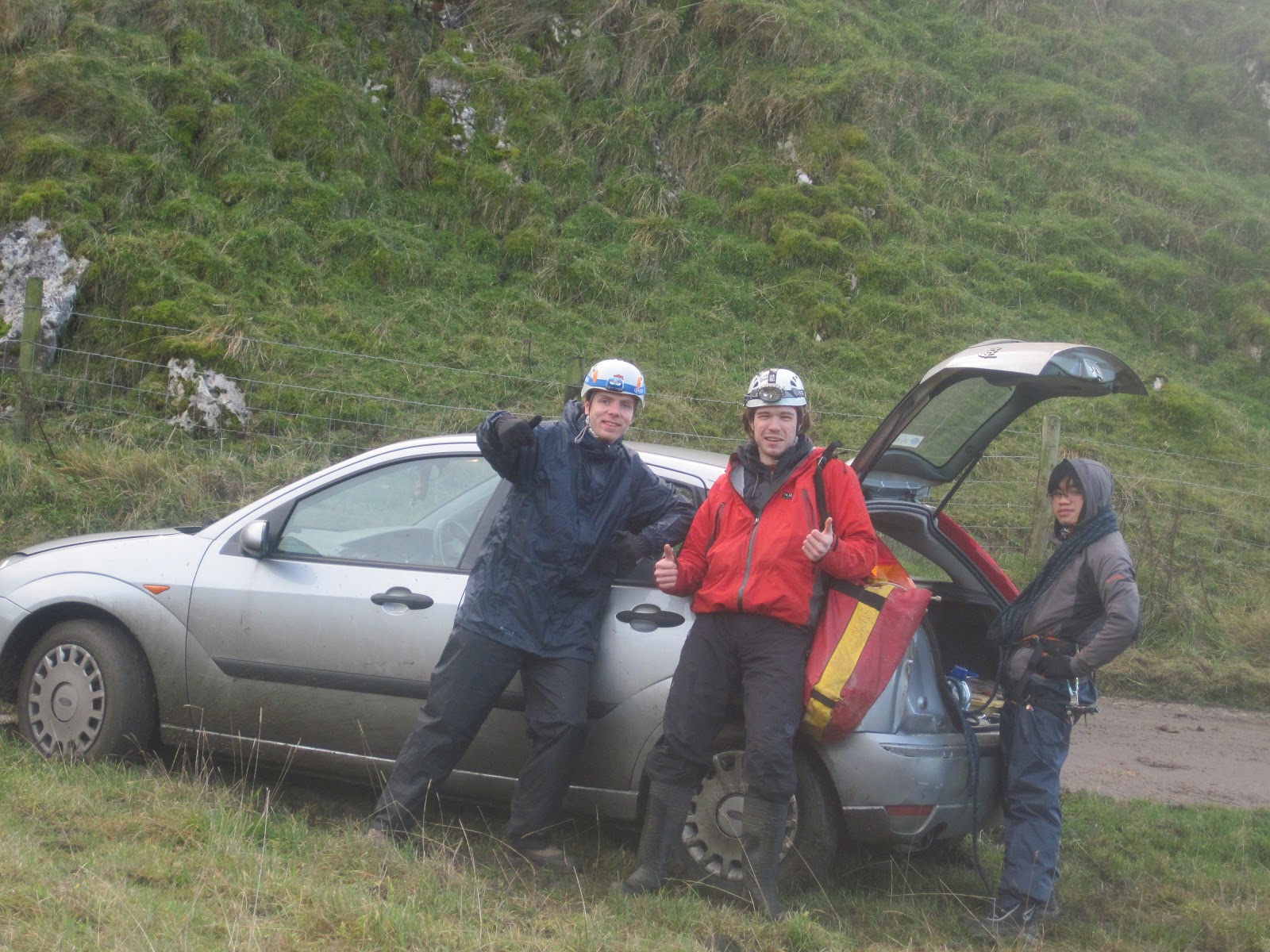
Originally I'd not intended to explore a cave that required any ropework, but when Finney and Ronnie both offer to use their rope our options opened up a little bit more. We settled in the end for Owl Hole in the Peak, billed as one of the largest natural open pots in the country. To be perfectly honest I don't know what I was expecting when we got there. We parked the car up at the side of the road, which mean that we reversed at high speed getting it stuck in the mud, but off the road at least and geared up with what we thought we would need.

What we thought we would need was a bit of an odd thing to consider as none of us had actually been properly caving before. I had a theoretical knowledge of caving rope ropework and a lot of it doesn't differ much from rock climbing. Even though it uses the same and similar equipment there is still a a big difference between the two. To the harnesses, jumars and 'biners we added helmets, headtorches, some food and water, cameras, first aid kit and our guidebook. All of this got crammed into an old caving sack that Staffs Uni MC uses to hold their spare helmets... not today though.
I said I didn't know what to expect and this was true. I didn't think Owl Hole would be so small or so vegetated. I assumed that “one of the Derbyshires largest natural open potholes” would be much larger than it actually was. The guidebook describes how it used to be a filled with rubbish until 1993 when the National Park Authority cleaned it out. There's still evidence of rubbish everywhere, but it's subtly being covered by overgrowth. There are several different rifts and passages heading off from the base of the pothole and after some deliberating and checking the guidebook, we just dived into a tunnel heading towards the Chamber's Chamber.

Being rather gung-ho about the whole caving thing I volunteered to go first. This of course is a slight downside when your not comfortable with the idea of being alone in a cave but never the less I dived in anyway. There's clearly been some kind of dig going on, evidenced by the piles of rocks just outside the entrance and the planks of wood, buckets and clay everywhere. I'm not going to lie, but at first I struggled to try and stay clean. This of course was a pointless exercise and had you seen the inside of the cave you would have agreed with me. At the first junction I stopped (missing the Chamber's Chamber) and Ronnie took the lead following the Nomis Chambers until for some reason, we just turned round and went back.


Going back was a good idea because we actually found and had a decent look around the Chamber's Chamber this time. Not that there was much moving around but the chamber was composed of a hole in the the “ceiling” which you could get you head and shoulders through. The “ceiling” was actually a thin ceiling which was the base of a small pool (a puddle really) of clear water in a small cavern with flowstone covering the walls. It was a real delight to see such a beautiful place at the end of such a dirty tunnel.

Outside in thence back outside we didn't really waist any time descending into another pot, this time one that was grated with a metal cover (several pieces of metal actually) and lead into a chamber called Owl's bottom. Just after the entrance to Owl's Bottom there was a steeply downward angled passage which was covering in scaffolding. Any thought of going down there we put off because we thought it was unstable. It wasn't until we actually read up in the guidebook that the passage is safe and leads to some beautiful rock formations (a cascade of flowstone) and the deepest point in the caves. In Owl's Bottom we had a look around, but it was hardly impressive. There was old initials scratched into the ceiling, probably from miner's but there was no evidence of what they mined.

Our next challenge lay in the form of exploring the Crystal Pallas Chamber. This challenge started with a 7 metre bolt ladder which needed to be climbed before entering the tunnel. As the group “rope technician” (a position I was appointed, not asked for) I went up first in the finest display on climbing that a man can muster on slippy polished limestone in wellies. All I can say is thank god there where bolts to pull on as I wasn't getting up otherwise! With both Ronnie and Finney belayed up to me we set about looking for the Crystal Pallas Chamber.

Navigating in caves so far that day had been reasonably easy. They'd all be straight tubes and you had no choice of where to go. This was a little different as the passage we wanted was off to the left (or more accurately the east) of the main passage. We overshot this completely and ended up in Hoggmorton Aven. This Aven was quite beautifel inside, being reasonably high and having some amazing stalagtites, mites and columns. We'd have got more pictures inside but there was so much moisture in the air that it made flash photography almost worthless. While we were viewing the walls suddenly a bat made it's presence known to use and started flying round the cave. This freaked me out a little. We tried to find the passage we needed and not realising we were further than we should by I volunteered to push further on into the cave. This involved a tight squeeze.

I'm not going to lie, but I came very close to panicing. I'll got back and squeeze though that little section but this time it got me. We searched the whole of the Aven and then carried on moving back down the main passage looking for the exit, slowly convincing ourself it was blocked up... then we found it! A short passage with ended in a sudden drop. It was quite creepy to actually look at, but we'd found it and set about rigging things up. Rigging in caving follows the same principals are climbing, but it's more akin to access work or what we do when I'm route setting. I only know how to rig things because I've spent years reading up on caving to make up for the fact that I wasn't actually going underground. This rig was very simple and soon I've abseiled off into the chamber, leaving another device pre-rigged up for Andy to clip into and join me.

For a while I had the whole chamber to myself. It didn't feel horrible and scary but instead it felt thrilling. I'd managed to actually go caving, properly. This was massive as far as I was concerned! A real milestone in my life. Soon Finney and Ronnie joined me and we explore the chamber in it's entirety. There seems to be a lot of dig's going on in Owl Hole and this was evidenced by the buckets and mud everywhere. I guess the main feature of the chamber was the ceiling with it's massive columns hanging down and which had lead to some amazing formations on the cave floor. There was quite a lot of tape around as well. They tape off areas of the cave into walk ways to stop formations being damaged or even touched. Your skin is acidic and therefore the oils can damaged delicate formations, but other than that people are heavy handed and things break or get covered in mud. It's not like it rains down here to wash things off. The back of the chamber was a mass of loose material that had clearly fallen in at some point. We actually found roots (from the trees above?) which had forced their way through the weaknesses in the rock and now dangled in the cave. In our explorations I climbed half way down towards the Gour Chamber, but this proved very muddy and something we would have liked a rope for. We decided to save it for next time. 
(Some long shutter photography using a petzl duo 14 as a light source)

(beaturfiul crystals and rock formations growing in a small pool)

(The hanging ceiling)

(an attempt at long shutter team pic, sadly we all moved)
(A bat, we were careful not to disturb)
It probably sounds like the whole thing was plain sailing but we did have a few hiccups along the way. Ronnie took ages getting down to join us in the Chamber and we soon found out the reason why. His gri-gri was stuck covering the nose of a 'biner. It was wedged in place and took me ages to actually release it. Finney had never ascended a single rope before and both Ronnie and Finney had a real fight to actually get over the lip of the cave. The clay covering on the rope caused us to be rather slow as ascending and meant that my gri-gri 2 wasn't the best piece of kit for the job. It's too small to handle clayed up rope apparently. Instead Ronnie was sending the old style gri-gri and the shunt back down for us to use. On the final throw down, this mass of metal hit me in the arm.

Once we'd all topped out, I set about stowing the gear while Ronnie and Finney tried to cram themselves in a small hole they'd found (sadly it went no where) and tired hungry and bruised we headed out of the cave. Instead of the warm sunlight glow that had come down the main passage before there was an eerie cold light at the end of the tunnel. Darkness had fallen and it was close to pitch black outside. Undeterred (or more like with no choice) we abseiled off. Coiled the ropes and took the customary team photo and headed home.

I guess you could say our adventure wasn't over. To celebrate we planned to have some decent food and while Finney cooked me and Ronnie washed all the gear. And by all I mean all. I scrubbed out the gri-gri's and all the headwear in the kitchen sink which Ronnie washed all the clothes in the bath. Needless to say the house was a mess and while I stuck everything in the drier Ronnie had to mop and try and unblock the bath tub (which I think is still blocked). It was a damp end to a good day.

I got so much out of this day underground. What was really nice was the team work that went on, throughout the day with each of us fetching and carrying the bags of kit and ropes throughout the cave. Even though some of us had more defined roles (I was left to deal with ropework and rigging) we all pulled together really well. This carried on all evening while we all piled in to clean all the kit up. To be honest I don't think we'd have got it all done if not. It also made me realise how little I know about caves, caving, and how caves are formed. The guide book keeps mentioning things like phreatic tubes and I've no idea what they are. It was nice to look up and see rock formations on the ceiling that I'd no idea how they formed.

I basically couldn't wait to go again. 


Tuesday, 11 September 2012

Some fine welsh rock.

Climbing with Soames generally means I'll be climbing somewhere in North Wales, even if you've only actually got the one day to go climbing. But this is all good with me. If I could only climb in North Wales for the rest of my life, I still wouldn't get bored.

Our hatched plan was to decided on the move, so I just turned up with a stack of guidebooks and we drove off already putting off the inevitable decision about where to actually climb. The weather helped us make a decision as it was raining in the mountains... and you know what that means. That's right we ended up at the coast to clear skies and chill in the air. I was pretty annoyed on the walk in to main cliff as, yet again, I'd forgotten my camera!

We decided to go for a 2 star HVS 5a called Gauntlet. The short path down to main cliff was fine, but the vegetation was still soaked (as the sun had yet to move round) leaving us both with soaking wet rock boots to start the climb. I got to lead Pitch 1 (5a) which I found to be challenging but good. The climbing really was excellent. It followed and corner and groove system up until the belay. There was some excellent jamming and finger locks in the crack on the way up. I hardly had to actually pull on my arms at all. That said there was a lot of pushing off my arms and high stepping instead.

Annoyingly the belay was a hanging belay, with only 1 foothold to actually stand on. For the first 5 minutes it was alright but 30 minutes later the seemingly constant bruise that runs arcoss my back (from spending too much time in a harness) had flared up again. Still, suffering is fun, right?

Soames lead pitch 2 (4c) which from below looked again excellent and reasonably easy. It was not the case, well no wholly anyway. It was excellent, but it wasn't easy. I had more trouble seconding it that I did leading the first pitch (I think this might have more to do with the a possible disparity between how hard you find things depending on whether your on the sharp end or not, but more about that another time). Sadly this pitch although about 4 metres long only contained about 15 metres of rock climbing and 35 metres of gently making upward progress amongs loose rock, grass and mud. A normal top-out at Main Cliff really.

As we'd left lunch in the car we walked back from main cliff and started out drive home, with the intention of finding something to do in Llanberis Pass on the way. It took us a while to decide was to get on partly because there are few routes in my grade that Soames hasn't already done and partly because there was so much to choose from. We settled on a route called Cornix that claimed to be HVS 4c. It was put in '53 by Hugh Banner, apparently known for stiffly grading his routes. We were not disappointed.

This time Soames jumped on the lead but was back down soon after. There was something about the route that just seemed to get under his skin. It was quite unnerving as it's very rare that I've ever seen Soames have a bad day like that. He untied and offer me the lead, which I accepted and off I set. The climbing was again excellent, the rock however was not. This was not a bad thing in the slightest. It vastly increased the level of acceptable risk and completely changed how I climbed the route.

I lead all three pitches on this route, whilst digging deeper and deeper into my own mind trying to understand why I hadn't bailed off it. Pitch 1 was not 4b, well at least it wasn't in my mind. Maybe if I'd been brave enough to actually weight some of the loose holds it would have bee 4b. I was relieved to actually top out on that pitch, after I'd removed a load of loose rock and nearly killed 2 sheep in the process (apparently sheep don't recognize "below!").

Pitch 2 promised to be better (good climbing and little loose rock) in the guide, however this wasn't so. The climbing was better, though harder than stated in the guide (more like 5a than 4c) but the amount of loose rock was about the same as the first pitch! I remember finding a horrible loose flake and slowly realizing that I'd have to actually weight it to make the next move, above a very shallow spike runner. This was quickly followed by a series of mantle shelves and yet another host of loose rock being clear off. At least the belay was nice, nestled in the shade of a few trees.


And pitch 3? well after pitches one and 2 I wasn't expecting it to be 4a and this was confirmed  as I stood half way up, on a wet foothold I'd cleaned of moss with my other foot heel hooking a shallow flake to keep me on the wall. It certainly wasn't 4a climbing but that didn't stop it being excellent. I topped out and shouted I was safe, happy in the knowledge that I only had to walk off now.

On the descent I noticed that the large wall round to the side doesn't appear to have any lines on it, so maybe there's some new routing potential there? It was a great day and nice to be out climbing trad instead of clipping bolts.

Wednesday, 5 September 2012

Ecrins (the first post of many)

I've just got back from a week in Ecrin, France. I've been happily clipping bolts and climbing massive mountain routes in beautiful locations. Time passed too quickly out there, even though it feels like I've been gone for a month and now I'm back I just want to be away again. Life is simpler in a tent.

I can't seem to get over how big the Alps are. Even though where we were staying was higher than Snowdon (and higher than Ben Nevis in fact) the peaks were still towering above us. Everything natural seems bigger but all the human impacts (like towns, buildings, roads and people) seem so much smaller. It's a very humbling place to be, I guess you can realize how small you really are there. 

The climbing has been immense. We only went for long rock routes with no glacial approaches. This was for a few reasons. Soames has little ice experience and I although I've got some winter experience, I've not experience on glaciers. Also it meant that approaches could be done in trainers not big boots, and ice tools and crampons could be leave in a box under the bed (till the winter season returns!) thus meaning a smaller lighter pack. I actually used my little lowe alpine crag attack all week. With enough cramming and judicious deciding of what to actually carry it all fitted, and I was able to climb with it.

Actually the whole trip was immense. From driving for long hours, to dealing with the heat to enjoying a cold grande biere after each day. One of the amazing things was how many people we spoke to, and who made the effort to come over and speak to us. It wasn't like being in England where people seem to be confined to their own little groups and corrals of tents at the weekend. There was a vastly different atmosphere about the whole place. On top of all this we learned loads. We learnt little things that would make life a little easier and big things that would change the way we approached climbing bolted mountain rock.


It was a good trip.